
 Facebook
 X
X
 Pinterest
 Copy Link
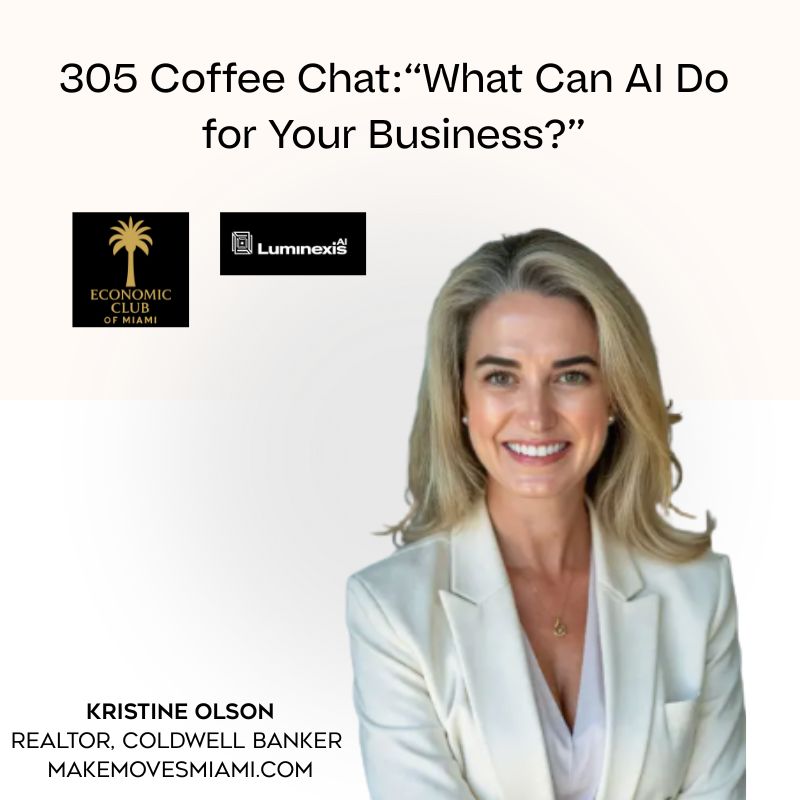
I recently had the opportunity to speak on a panel at the 305 Coffee Seminar, hosted by Luminexis.AI, where we explored a central question: “What Can AI Do for Your Business?” Bringing together innovators, executives, and industry professionals, the event highlighted how artificial intelligence is rapidly transforming business strategy across sectors – including real estate.
How I Use AI in My Real Estate Business
As a newer agent, I have been able to build my business from day one with AI woven directly into my workflow. This has allowed me to establish strong operational discipline, high-quality output, and consistency across client touch points.
AI plays a significant role in:
• Website development and content creation: research, listing descriptions, contracts, and addendums.
• Productivity and client organization: using tools like Quo, which provides prompt-based templates to streamline communication.
• Property marketing: leveraging AI Virtual Home Staging (a complimentary tool through the Miami Association of Realtors) to enhance images, remove or add furniture, and make rapid visual updates to flooring, decor, and layout.
These capabilities allow clients to visualize possibilities faster and make more informed decisions.
Where the Industry Is Today
Across the real estate sector, AI adoption is accelerating – especially in marketing.
• Approximately 58% of realtors now use ChatGPT in their day-to-day work according to the National Association of Realtors. nar.realtor.com
• AI-assisted listing descriptions and social media content have become standard tools.
Despite the momentum, many agents are still navigating the learning curve and evaluating cost versus ROI, particularly as new platforms emerge.
Tools and Systems Driving Real Value
Not all transformational tools are strictly “AI” and this is an important nuance. Certain digital systems have already shifted how agents operate and how clients expect to do business.
• E-signature platforms, now used by nearly 80% of agents, remain one of the most impactful operational improvements.
• Clients consistently value speed, convenience, and efficiency, and technology enables that.
• As a business owner, deciding which tools deliver meaningful ROI continues to be a critical part of my decision making.
What Has Surprised Me Most About AI
While AI is powerful, certain skills remain irreplaceable. Critical thinking, judgment, interpersonal skills, and emotional intelligence continue to differentiate strong agents as trusted advisors with fiduciary responsibility to their clients.
One interesting shift is that clients are now using AI to prepare questions in advance, which means buyers and sellers are entering conversations more informed and with clearer expectations. This elevates the quality of dialogue and makes expertise even more important.
What’s Next: The Future of AI in Real Estate
Over the next 3–5 years, AI will reshape workflow automation, CRM follow-up, and agent productivity more than any other area of the business. Leaders who take the initiative now – learning the tools, refining processes, and embracing automation – will have a competitive advantage. This is particularly relevant today as Coldwell Banker prepares for its merger with Compass, signaling a broader shift toward technology-driven operations and integrated smart platforms.
Key Takeaways from the Seminar
The event also highlighted the forward-thinking leadership of Luminexis.AI President Ramon Tisaire and CTO Chandra Kanive, who set the tone for responsible, strategic AI adoption. Our Fireside Chat, featuring Aurora Martinez Ramos, Serge Permyakoff, and myself, sparked dynamic discussion around AI readiness, change management, and how businesses can prepare for rapid transformation. We are grateful to the Economic Club of Miami for sponsoring the seminar and to Shutts & Bowen for hosting us. Their support made this conversation possible for Miami’s expanding business community. As AI evolves, so will the opportunities for real estate professionals to serve clients more effectively.
