
 Facebook
 X
 Pinterest
 Copy Link
Miami traffic is a familiar conversation. Whether commuting to work, traveling between Miami and Fort Lauderdale, or heading north to Palm Beach for business or leisure, getting around South Florida can be a challenge.
What if we looked at mobility differently? Not simply as a traffic problem, but as a fundamental part of how our region grows, attracts investment, creates opportunity, and shapes where people choose to live?
That was the central theme of the Economic Club of Miami event, “The Business of Mobility: How Florida Moves People, Commerce and Opportunity,” moderated by Erika Donalds. The discussion brought together transportation leaders to explore the infrastructure and innovation behind Florida’s continued growth.
As someone who lives in Miami and regularly travels throughout South Florida, I found the conversation particularly relevant, not only from a business perspective, but also in considering the future of our real estate market.
South Florida Is Becoming an Increasingly Connected Corridor
South Florida is more than a collection of individual cities. Miami, Fort Lauderdale, Boca Raton, Palm Beach Gardens, and Jupiter, form an interconnected economic corridor where people, businesses, and investment move daily.
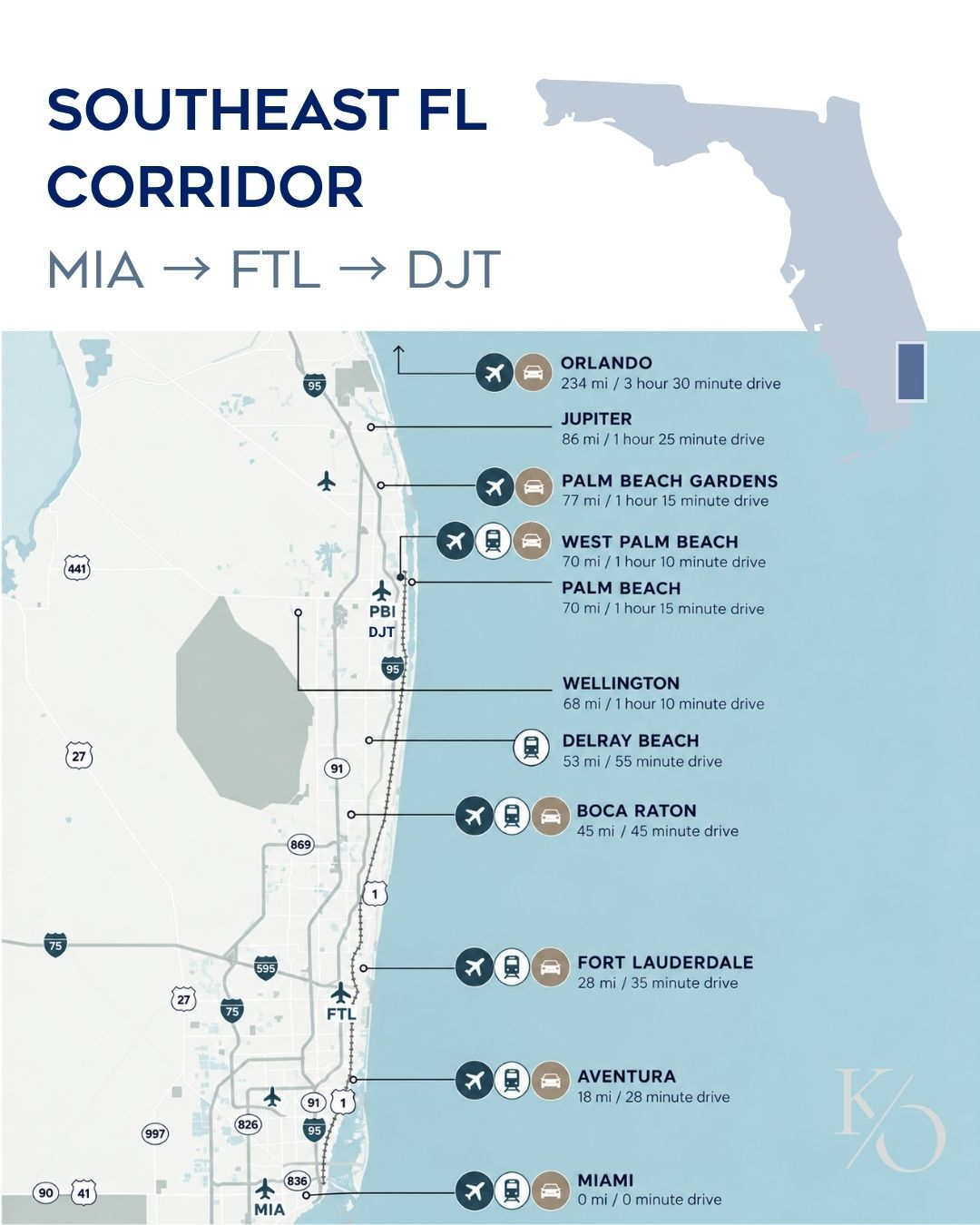
The Southeast Florida Corridor: Connecting Miami (MIA), Fort Lauderdale (FTL), and the Palm Beach (DJT) region, with access to major airports, highways, and rail connections.
The map illustrates the geographic relationships between these communities and the transportation networks that connect them. Each market has its own character, employment centers, residential neighborhoods, and lifestyle offerings, yet all are influenced by how efficiently people can move between them. As the region continues to grow, transportation capacity and connectivity will play an increasingly important role in how South Florida develops.
Three Perspectives on the Business of Mobility
1. Travel Technology: Making Movement More Seamless
Caryn Seidman Becker, Chairman and CEO of CLEAR, offered a perspective on how technology can improve the travel experience. CLEAR was developed in response to the security challenges that followed September 11, with a model built around enrolling once and using that identity-verification service across participating locations.
The broader takeaway is that mobility is not just about physical infrastructure. It is also about reducing friction in the travel experience through technology, operational efficiency, and better-connected systems. As airports and transportation hubs serve growing numbers of travelers, innovations that make the journey more seamless become an important part of the overall travel ecosystem.
2. Brightline: Growth Requires Infrastructure
Patrick Goddard, CEO of Brightline, addressed one of the central challenges facing a growing region: growth without infrastructure = congestion.
That idea resonates throughout South Florida, where population growth, employment, tourism, and development place increasing demands on existing transportation networks.
Brightline represents an alternative to driving between major South Florida destinations, connecting communities along the corridor through intercity passenger rail.
One particularly interesting point was the potential relationship between transportation and housing affordability. When people have more viable transportation options, the range of communities they can realistically consider living in may expand. That makes transportation planning relevant not only to commuters, but also to the broader housing conversation.
3. PortMiami: Connecting Florida to Global Commerce
Jonathan Daniels, Director and CEO of PortMiami, brought the discussion to another essential component of South Florida’s economy, maritime commerce.
PortMiami is internationally recognized for its cruise operations and also serves as a critical link in cargo movement. Its role illuminates how transportation infrastructure supports more than the daily commute. Ports, airports, highways, and rail networks help connect Florida to national and global markets.
For a region with strong international connections, tourism, and commercial activity, the performance of these transportation networks has implications that extend well beyond the transportation sector itself.
Several implications stand out:
- Accessibility can expand housing choices. When transportation options make it easier to reach areas of employment, people may be able to consider a wider range of neighborhoods and communities.
- Infrastructure can influence development patterns. Major transportation connections can affect where businesses locate, where new projects emerge, and how neighborhoods evolve over time. The relationship between transit and development is not automatic, but connectivity is an important factor to evaluate.
- Regional connectivity strengthens South Florida’s appeal. The ability to access international air travel, major employment hubs, cultural destinations, ports, and neighboring cities contributes to the region’s overall economic and lifestyle proposition.
For buyers evaluating Miami and the surrounding markets, these factors are worth considering alongside price, property characteristics, insurance costs, and other ownership expenses. For investors, understanding planned infrastructure and actual transportation access can provide additional context when evaluating a property’s location.
Looking Beyond the Traffic Conversation
South Florida’s transportation challenges are real, but the discussion at the Economic Club of Miami offered a future-focused, practical manner in addressing the future growth.
Mobility sits at the intersection of infrastructure, technology, commerce, housing, and economic opportunity. Addressing the region’s needs will require continued investment, coordination, and thoughtful planning as communities grow and become more interconnected.
As I work with real estate clients, I will continue to look beyond an individual property to the broader forces shaping each community. Understanding transportation connections, employment centers, and regional development are all a part of understanding the full value of a location, now and in the future. As I serve the Southeast Corridor of Florida, for buyers, sellers and renters, connect if you would like to discuss.
Kristine Olson
Make moves with confidence.

